
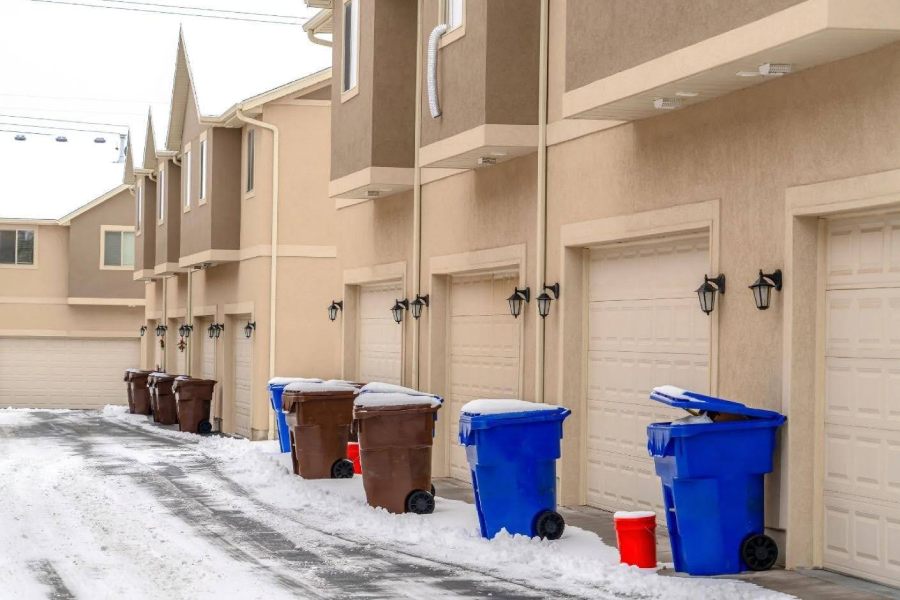
Every HOA has its version of the great trash-can debate. One neighbor rolls the bins out too early. Another parks in the guest spot every night. Someone’s dog believes 6 a.m. is the ideal time to announce the arrival of every squirrel.
The board inbox fills up, and suddenly volunteer directors feel like neighborhood referees.
The key distinction: An HOA should address issues within its governing authority, not every disagreement between neighbors. Knowing where that line sits can save everyone time and frustration.
Complaint number one: the trash can that never goes home
A resident leaves bins beside the garage all week. Is that an HOA violation?
It depends on the rules and property classification. An association may have enforceable standards for container storage, pickup days and common-area cleanliness. But if the rules are silent, the board should be careful about inventing an on-the-spot penalty.
A better approach: Publish a clear storage standard, give residents practical reminders, and apply enforcement consistently. Consider whether local municipal requirements also apply.
Complaint number two: “Someone took my parking spot”
Parking disputes are rarely just about parking. They are often about what the space actually is.
Assigned versus unassigned spaces
A numbered stall may be assigned by declaration, deed, lease or board policy. A guest space generally serves a different purpose. The board should confirm the legal allocation before treating a space as someone’s exclusive property.
Public streets versus private property
An association’s authority over public streets may differ from its authority over private roads and common parking areas. A rule that works in an association-owned lot may not be enforceable the same way on a city street.
For a deeper explanation, see Minnesota HOA parking rules and enforcement.
Complaint number three: the dog with opinions
Barking, unleashed pets and waste cleanup can create genuine quality-of-life concerns. But boards need to distinguish between ordinary pet ownership, documented nuisance conduct and issues involving disability accommodations or assistance animals.
A blanket response like “no exceptions” can create legal risk. Boards should evaluate requests involving assistance animals under applicable fair-housing law and obtain professional guidance when needed.
See Minnesota HOA pet policy guidance for more context.
Complaint number four: the neighbor who is just… annoying
Not every unpleasant interaction is a rule violation. A disagreement about tone, a personal feud or a neighbor who does not say hello is generally not something the HOA can fix.
When a complaint concerns threats, suspected criminal conduct or immediate safety, the appropriate response may involve law enforcement or emergency services rather than HOA enforcement. For ordinary neighbor friction, direct communication or voluntary mediation may be more effective.
A simple decision tree for board members
When a complaint arrives, ask:
- Is there an identifiable rule or declaration provision? If not, do not invent one retroactively.
- Does the association have authority over the location or behavior? Check property ownership and jurisdiction.
- Is there usable evidence? Dates, photographs and specific descriptions are more helpful than rumors.
- Has the owner been given the required notice and opportunity to respond? Follow the association’s process and applicable law.
- Would the same standard be applied to another resident? Consistency matters.
For broader conflict-management strategies, read HOA dispute resolution in Minnesota and how to handle noise and nuisance complaints.
A Twin Cities scenario: three complaints, one meeting
Imagine a 70-unit townhouse association in Eagan. The board receives three messages before its monthly meeting: a recycling bin left outside, a car parked overnight in a visitor stall and a dog barking during the afternoon.
A productive board does not devote 45 minutes to deciding who is “right.” It checks the written trash rule, confirms whether visitor parking has a time limit, and requests dates and duration for the barking concern. The issues are then handled through the appropriate channels with neutral communication.
The lesson: process beats personality.
How homeowners can make complaints easier to resolve
- Report facts, not motives.
- Include the date, location and what happened.
- Provide photographs when appropriate without invading privacy.
- Avoid confrontational group emails.
- Allow time for the association’s stated process.
- Remember that the board may not be able to disclose another owner’s enforcement details.
What to do next
Boards should review the top five recurring complaints and ask whether the rules are clear, lawful, practical and consistently enforced. Create a simple intake form and escalation path. Homeowners should use the established reporting channel and distinguish a personal disagreement from a documented violation.
For help creating a calmer, more consistent association process, explore professional Minnesota townhouse and condominium management, EPMI board resources, and the EPMI blog.
If your board spends more time settling neighbor disputes than managing the community, contact Exclusive Property Management Inc. about professional HOA administration.
Frequently asked questions
Can an HOA fine someone for leaving trash cans outside?
Possibly, if a valid rule and lawful enforcement procedure authorize the fine. Boards should verify notice and hearing requirements before imposing penalties.
Can an HOA enforce parking on a public street?
Its authority may be limited. Public-street parking is generally subject to government regulation, and boards should confirm any claimed HOA authority with counsel.
Does the HOA have to respond to every neighbor complaint?
A board should have a reasonable intake and triage process, but it is not required to resolve every personal disagreement. Its role depends on association authority and the issue.
Can the HOA ban a barking dog?
Pet and nuisance restrictions may apply, but enforcement should be based on documented conduct and applicable law, including fair-housing obligations.
Should homeowners confront their neighbors first?
For minor, nonthreatening issues, a respectful conversation may help. Residents should not confront someone when they feel unsafe.