
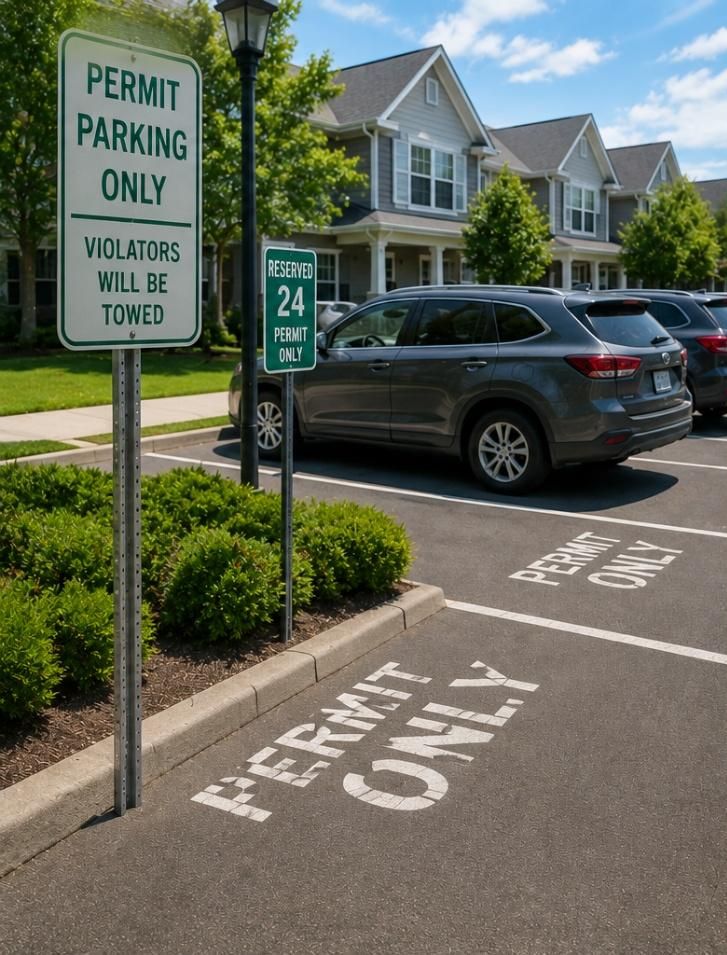
HOA parking rules in Minnesota govern where homeowners and guests may park, how long vehicles may remain, what types of vehicles are permitted, and how violations are handled. Effective parking rules are specific, consistently enforced, and properly communicated so that every homeowner understands the expectations before a conflict arises.
Parking is one of the most reliably contentious topics in HOA governance. It is tangible, daily, and deeply personal. A homeowner who cannot park in front of their own home, or who watches a neighbor’s third car sit in a guest spot indefinitely, feels the friction immediately. Boards that handle parking well reduce a major source of neighbor conflict. Boards that do it poorly spend more time on parking enforcement than almost any other issue.
Why Parking Rules Require More Precision Than Most Boards Give Them
Vague rules are enforced inconsistently, and inconsistent enforcement is the leading cause of homeowner complaints about HOA parking policies. When one neighbor gets a warning and another gets a fine for the same violation, the board looks arbitrary and the homeowner who was fined feels targeted.
The root cause is almost always that the rule itself was not specific enough. “No overnight parking on the street” sounds clear until someone asks what overnight means, whether a commercial vehicle counts as a vehicle, and whether the rule applies to guests or only residents.
Before your board can enforce parking rules effectively, it needs rules that answer these questions in writing.
What Minnesota HOA Parking Rules Should Address
Assigned Parking and Common Lot Rules
If your association has assigned spaces, your rules should clearly define what happens when a homeowner parks in another’s space, what visitors are allowed to use, and how a resident requests a tow for an unauthorized vehicle. If you have shared or unassigned guest lots, define how many spaces a household may use, and whether any first-come, first-served lots have time limits.
Street Parking
Many Minnesota HOA communities restrict or prohibit street parking entirely, particularly in townhome and single-family developments with narrower internal roads. If street parking is allowed, address time limits, overnight rules, and whether the policy differs from city ordinances. Note that city parking ordinances apply even within private HOA streets in most cases, unless the roads are fully private. Your board should know which applies in your community.
Overnight Parking Policies
Overnight parking restrictions are common and often necessary for safety and appearance reasons. If your association restricts overnight parking, define the hours clearly, for example, no parking on common roadways between midnight and 6:00 a.m., and specify whether exceptions exist for situations like home repairs, moving, or temporary medical need.
Commercial Vehicles and Recreational Vehicles
This is one of the most common sources of disputes in Minnesota HOA communities. Boards should decide and document policies for:
- Pickup trucks with commercial markings or signage
- Vans with business names
- Boats, jet skis, and trailers (especially relevant given Minnesota’s lake culture)
- RVs and campers
- Utility trailers and construction equipment
Minnesota homeowners who own recreational watercraft often push back on storage restrictions, which is understandable given how central lake recreation is to the state’s culture. Boards can address this by being specific about where and for how long seasonal equipment may be stored, rather than issuing a blanket prohibition that feels disconnected from local norms.
Inoperable or Abandoned Vehicles
Define what constitutes an abandoned or inoperable vehicle and how long one may remain before the board takes action. Including a visual standard, such as a vehicle that has not moved in 30 days, has expired plates, or is missing required equipment, reduces the subjectivity that leads to enforcement disputes.
Building a Legally Sound Enforcement Process
Having the right rules matters. Having the right process to enforce them matters just as much.
Connect Rules to Your Governing Documents
Before you enforce a parking rule, confirm that it is authorized by your declaration, bylaws, or a properly adopted rule. Rules that boards invented informally and never formally adopted are difficult to enforce and create legal exposure. For a thorough overview of the legal framework governing HOA rule-making and enforcement authority, Minnesota HOA laws every board should know is essential reading.
Build a Warning-Fine-Escalation Structure
One common mistake boards make is jumping straight to fines without a documented warning step. Most governing documents require notice before a fine can be levied. A typical enforcement ladder looks like this:
- First violation: written notice with a specific timeframe to correct
- Second violation: written notice plus a fine
- Third and subsequent violations: escalating fines and possible towing authorization
- Unresolved or egregious violations: hearing before the board and potential suspension of privileges
Document each step, send notices in writing (email plus postal mail is safest), and keep copies in the homeowner’s file.
Authorize Towing Carefully
Towing a vehicle is the most aggressive enforcement tool available and the one most likely to generate a complaint or a legal challenge. Before your board authorizes towing, confirm that:
- Your governing documents explicitly authorize it
- Proper signage is posted at all entrances and in the parking area
- You have a signed contract with a towing company that complies with Minnesota towing statutes
- You provide required notification to the vehicle owner where practicable
For disputes that escalate beyond a towing notice, HOA dispute resolution in Minnesota covers the process for giving homeowners a fair hearing before enforcement actions become final.
Communication: Getting Rules to Homeowners Before Enforcement Starts
Boards cannot fairly enforce rules that homeowners did not know existed. Before stepping up parking enforcement, particularly if rules are new or newly updated, communicate the changes with adequate lead time.
Send a written notice to every homeowner, post the rules in your community portal, and consider a 30-day grace period before fines begin if you are rolling out a significant change. This approach reduces the “I didn’t know” defense in enforcement disputes and demonstrates that the board acted in good faith.
The same principles that make parking rules work are part of a broader framework of clear, consistent community policies. Our post on why clear HOA rules actually make communities better is worth reviewing alongside your parking policy work. And if your board is also evaluating summer amenity policies at the same time, HOA pool and amenity rules require a similar enforcement-first approach.
A Real-World Scenario: The RV That Divided a Neighborhood
A townhome association in an outer-ring Minneapolis suburb had no written RV or trailer policy. When a homeowner parked a large camper in the guest lot every summer starting in late May, other residents complained that it was taking three spaces and blocking sightlines.
The board sent the homeowner a letter asking him to move the RV. He responded that no rule prohibited it and asked the board to point to the specific provision they were enforcing. They could not, because one did not exist.
The board had two options: enforce an informal rule and invite a legal challenge, or admit the gap and adopt a proper policy. They chose the latter, worked with their HOA attorney to draft an RV and oversized vehicle policy, formally adopted it at a board meeting, and gave all homeowners 60 days notice before it took effect. The homeowner complied when the rule was in place, and two other residents who had similar questions about boat trailers now had a clear answer as well.
The lesson: retroactive enforcement of unwritten rules is the fastest way to lose a dispute. Rules adopted transparently and applied prospectively almost always hold up.
Frequently Asked Questions
1. Can a Minnesota HOA tow a vehicle without notice?
In most cases, no. Minnesota has specific statutes governing towing from private property that require proper signage and, in some cases, advance notice to the vehicle owner. HOA towing policies must comply with both your governing documents and state law. Consult your HOA attorney before authorizing any tow.
2. Can an HOA restrict pickup trucks or commercial vehicles in Minnesota?
Yes, if the restriction is in your governing documents or a properly adopted rule. Many associations restrict commercial vehicles with visible signage or markings. However, a blanket ban on all pickup trucks is generally difficult to enforce and may invite challenges. Boards should focus on specific, objective criteria like visible commercial signage.
3. What if a homeowner parks in a way that blocks emergency access?
This is an immediate safety issue. Boards should contact local emergency services if access is genuinely blocked, and the vehicle may be eligible for immediate towing under Minnesota law regardless of your normal warning process. Document everything and follow up with a formal violation notice.
4. How do we enforce parking rules fairly when some homeowners seem to get special treatment?
Consistent documentation is the answer. Every violation should be reported, recorded, and responded to through the same process, regardless of who the homeowner is. If a board member’s family member receives different treatment, that is a governance failure. Consider using a property management company to handle enforcement to remove the appearance of favoritism.
5. Can an HOA restrict where guests park in Minnesota?
Yes. HOAs can designate specific areas for guest parking and restrict guest use of homeowner-assigned spaces. Rules should be posted clearly and communicated to homeowners so they can inform their guests. Including guest parking rules in your welcome materials reduces first-offense conflicts.
Final Thoughts
Parking enforcement is one of those areas where a small upfront investment in clear rules and a fair process pays dividends every summer. Boards that take the time to audit their parking policies, close the gaps, and communicate the standards before enforcement begins avoid the vast majority of disputes that otherwise land on their agenda.
EPMI supports Minnesota HOA boards in developing and administering parking policies that are legally grounded, consistently applied, and clearly communicated. If your board is wrestling with a parking situation or wants help reviewing your current rules, reach out. We have seen most of it before and are happy to help.