
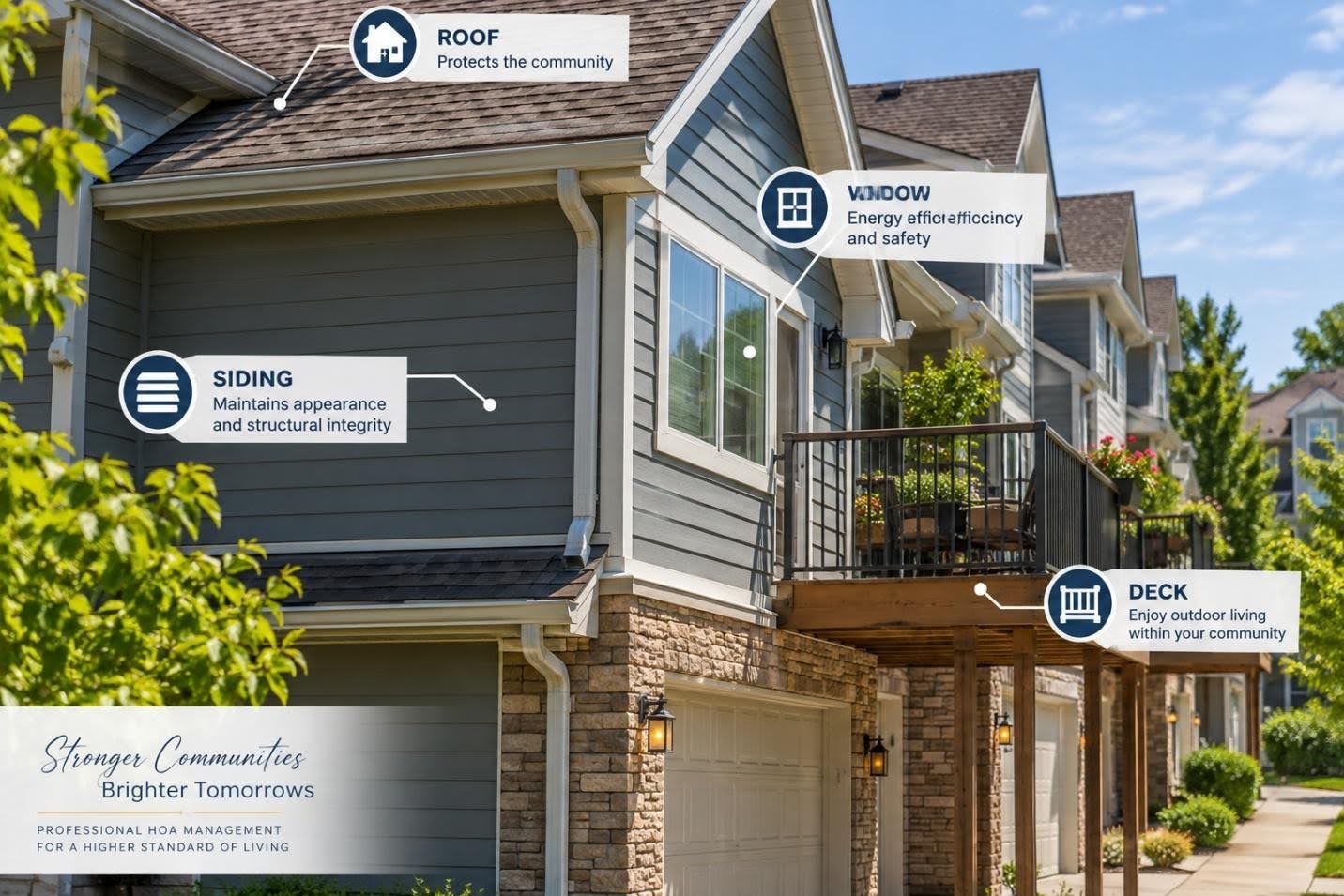
Repair responsibility in a Minnesota HOA is divided between the association and individual homeowners based on what the governing documents define as common elements, limited common elements, and individually owned property. When something breaks, the answer to “who pays for this?” almost always starts with those documents and the Minnesota Common Interest Ownership Act (MCIOA).
If you’ve ever sat through a board meeting where a homeowner insists the HOA should fix their balcony, or a board member assumes a leaking pipe is the homeowner’s problem because it’s “inside their unit,” you already know how quickly repair responsibility can become a source of conflict. In the Twin Cities metro, where freeze-thaw cycles put relentless pressure on roofs, foundations, driveways, and plumbing, getting this right isn’t just good governance. It’s essential to protecting your community’s property values and your reserve fund.
How Minnesota Law Sets the Framework
Minnesota’s primary statute governing HOAs and condominiums is the Minnesota Common Interest Ownership Act, commonly referred to as MCIOA. It establishes baseline rules for what associations must maintain and what homeowners are responsible for, but it explicitly defers to each association’s declaration and bylaws on many of the specifics.
This means the law gives your governing documents enormous authority. It also means that two HOAs in the same Bloomington subdivision could have genuinely different repair obligations, depending on how their declarations were written.
What MCIOA Generally Requires Associations to Maintain
Under MCIOA, associations are generally required to maintain, repair, and replace common elements. These typically include:
- Shared structures such as roofs, exterior walls, and foundations in condominium settings
- Common area amenities like pools, clubhouses, and fitness facilities
- Shared landscaping and grounds in communities where the HOA owns that land
- Parking lots, private roads, and sidewalks that are part of the common area
- Shared mechanical systems such as elevators or centralized HVAC
The language “common element” is doing a lot of work in that list, which is exactly why your declaration matters so much.
Where Homeowner Responsibility Typically Begins
In most Minnesota HOAs, homeowners are responsible for everything within their unit or lot that is not designated as a common element. This commonly includes:
- Interior walls, flooring, and fixtures
- Individual HVAC systems serving only their unit
- Windows and doors in single-family HOA communities (though this varies significantly in condos)
- Decks, patios, and fences that are within a homeowner’s lot boundary
- Appliances and plumbing fixtures within the unit
The line between “inside the unit” and “part of the structure” is where most disputes originate, and Minnesota’s harsh winters make those disputes more frequent. A pipe that freezes in an exterior wall, a roof leak that enters through a shared surface, a driveway heaved by frost — each of these can land in genuinely ambiguous territory.
Limited Common Elements: The Source of Most Repair Disputes
If common elements belong to the association and unit interiors belong to homeowners, limited common elements are the category that generates the most confusion and conflict. A limited common element is a portion of the common elements assigned to the exclusive use of one or more — but not all — units.
Balconies, patios, assigned parking spaces, and individual unit entry doors in a condominium are frequent examples of limited common elements. The critical question is always: who maintains them?
Under MCIOA, the association is generally still responsible for maintaining limited common elements unless the declaration shifts that responsibility to homeowners. Many declarations do shift at least some of that responsibility. Some declarations say the homeowner is responsible for routine cleaning and maintenance but the association handles structural repairs. Others assign full responsibility to the homeowner. Still others leave it ambiguous, which is where boards need legal guidance.
One common mistake we see is boards assuming that because a homeowner uses something exclusively, they must be responsible for maintaining and repairing it. That assumption is not supported by MCIOA as a default. Your declaration controls, and if the declaration is silent, the association likely has the obligation.
Reading Your Governing Documents: The First Step for Any Repair Dispute
Before your board weighs in on any repair dispute, the conversation should start with the governing documents. In Minnesota HOAs, the relevant documents are typically:
- The Declaration (also called the CC&Rs) — this is the primary source for defining common elements, limited common elements, and maintenance obligations
- The Bylaws — these cover procedural rules but may also address repair processes
- Any Rules and Regulations the board has adopted
We often see boards skip this step under time pressure, especially when a repair feels urgent (a leaking roof in January, for example). That shortcut frequently creates bigger problems. If the board pays for something that is actually the homeowner’s responsibility under the declaration, it may be difficult to recoup that cost and sets a precedent that is hard to walk back.
If your governing documents are ambiguous, that is a signal to consult your HOA attorney before making a decision, not after. The cost of a legal consultation is almost always less than the cost of an improper repair payment or a dispute that escalates into litigation.
For context on how financial decisions like these interact with your overall budget, the post on how Minnesota weather impacts HOA budgets and planning covers the seasonal dimensions that make repair funding particularly challenging in the Twin Cities.
Winter and Seasonal Repair Responsibility in Minnesota HOAs
Minnesota’s climate creates repair situations that HOAs in warmer states rarely encounter. Freeze-thaw cycles, ice dams, heavy snow loads, and frost heave are recurring realities for Twin Cities communities, and they raise specific questions about repair responsibility that your board should address proactively.
Ice Dams
Ice dams form when heat escapes through the roof, melts snow, and the meltwater refreezes at the eaves. The resulting damage — water intrusion into ceilings, walls, and insulation — can be extensive and expensive. In a condominium, the roof is almost always a common element, which means ice dam prevention and the resulting structural repairs are typically the association’s responsibility. However, damage to a homeowner’s interior belongings or finishes may fall to their individual HO-6 insurance policy. The line between structural water damage (association’s problem) and personal property damage (homeowner’s problem) matters enormously here.
Frozen and Burst Pipes
Frozen pipes inside an individual unit, particularly those that serve only that unit, are generally the homeowner’s responsibility in most Minnesota declarations. Pipes that run through shared walls or common mechanical spaces are more likely to be the association’s responsibility. When a pipe bursts and causes damage to multiple units or common areas, insurance and subrogation questions arise quickly, which is why understanding your HOA insurance coverage is essential before a loss event occurs.
Driveways, Parking Lots, and Sidewalks
In single-family HOA communities, driveways within a homeowner’s lot are typically the homeowner’s responsibility, while shared roads and parking lots are the association’s. Frost heave damage to shared surfaces should be budgeted as a recurring maintenance cost. Boards that don’t account for this in their reserve fund often face pressure to levy special assessments. For boards planning ahead, understanding HOA reserve funds is a good starting point for thinking through long-term repair funding.
A Real-World Scenario: The Balcony Dispute in a Plymouth Condo
A condominium association in Plymouth had a homeowner request that the HOA repair structural rot on her exclusive-use balcony. The board’s initial instinct was to deny the request, reasoning that because the balcony was for her exclusive use, it was her responsibility.
Before responding, the board’s property manager pulled the declaration and found that while homeowners were responsible for “cleaning, painting, and routine upkeep” of their balconies, structural repairs remained the association’s obligation. The board had been operating under an incorrect assumption for years and had denied a similar request from a different homeowner two years earlier.
The association ended up covering the structural repair, issuing a formal correction to its earlier denial, and amending its repair policy document to reflect the declaration language accurately. The lesson: written policy that contradicts your declaration is not enforceable and creates legal exposure. Review your policies against your governing documents regularly, and when you take over as a new board, make reading the declaration a priority before you make any repair decisions.
When Homeowners Cause Damage to Common Areas
A situation that comes up frequently in well-maintained communities is a homeowner who causes damage to a common element — a contractor they hired who cracks a shared wall, a vehicle that damages a parking structure, a renovation that compromises a common plumbing stack. In these cases, most declarations allow the association to charge the repair cost back to the responsible homeowner, sometimes including reasonable legal and administrative fees.
Your governing documents should include language covering this scenario. If they don’t, it’s worth discussing with your HOA attorney whether a rule or policy amendment is appropriate. Documenting the damage promptly, with photos and written communication, is essential regardless of what your documents say.
For boards navigating the process of enforcing these kinds of obligations, the post on handling delinquent HOA dues and collections in Minnesota covers related enforcement principles that apply to charged-back repair costs as well.
The Role of a Professional Property Manager in Repair Oversight
One area where professional management adds consistent value is in repair oversight — specifically, knowing which repairs to refer to the association’s vendors, which to refer back to homeowners, and how to document decisions in a way that reduces liability.
A professional manager can also help your board maintain a repair log that tracks who was responsible for what, when it was addressed, and what the outcome was. That documentation matters if a homeowner ever disputes a decision or if a repair-related claim is filed.
Boards managing these responsibilities on their own often find that repair disputes are among the most time-consuming and emotionally draining aspects of the role. Understanding what a professional HOA management company actually does can help boards evaluate whether outside support makes sense for their community.
Frequently Asked Questions
1. Who is responsible for HOA repairs in Minnesota?
Responsibility is divided based on your association’s governing documents and the Minnesota Common Interest Ownership Act. The HOA is generally responsible for common elements, while homeowners handle repairs within their individual units or lots. Limited common elements — like balconies or assigned parking — depend on what your declaration specifically says.
2. What are limited common elements, and who maintains them in Minnesota?
Limited common elements are portions of the common elements reserved for the exclusive use of one or more homeowners, such as individual balconies, patios, or assigned parking spots. Under MCIOA, the association typically maintains them unless the declaration expressly shifts that duty to homeowners. Many declarations do reassign some or all maintenance, so boards must read their documents carefully before making a determination.
3. Is the HOA responsible for ice dam damage in Minnesota?
In most condominium communities, the roof is a common element and ice dam prevention and structural water damage repairs fall to the association. Damage to a homeowner’s personal property or interior finishes is generally covered by the homeowner’s individual HO-6 insurance policy. The distinction between structural damage and personal property damage is important and should be reviewed with your insurance carrier and HOA attorney.
4. Can an HOA charge a homeowner for repairs the homeowner caused?
Yes. Most Minnesota declarations include provisions allowing the association to charge back repair costs to a homeowner whose actions or negligence caused damage to common elements. Boards should document the damage thoroughly and follow the process outlined in their governing documents, including any required notice to the homeowner before costs are assessed.
5. What should a Minnesota HOA board do when repair responsibility is unclear?
Start with the governing documents — specifically the declaration — and look for language about the specific element in question. If the documents are ambiguous or silent, consult your HOA attorney before authorizing the repair or denying a homeowner’s request. Acting without clarity can set precedents that are difficult to reverse and may create legal exposure for the board.
Final Thoughts
Repair responsibility is one of the most practical and recurring challenges for Minnesota HOA boards, and the Twin Cities climate gives communities fewer opportunities to defer the question. Getting it right means knowing your governing documents, applying MCIOA correctly, and building the documentation habits that protect your board when disputes arise.
If your board is spending significant time navigating repair disputes or is unsure how your declaration aligns with your current policies, EPMI works with associations across the Twin Cities metro to clarify responsibilities, strengthen vendor oversight, and ensure repair decisions are well-documented and legally sound. Reach out to learn how professional management support can reduce the burden on your board and help your community stay ahead of Minnesota’s demanding maintenance calendar.