
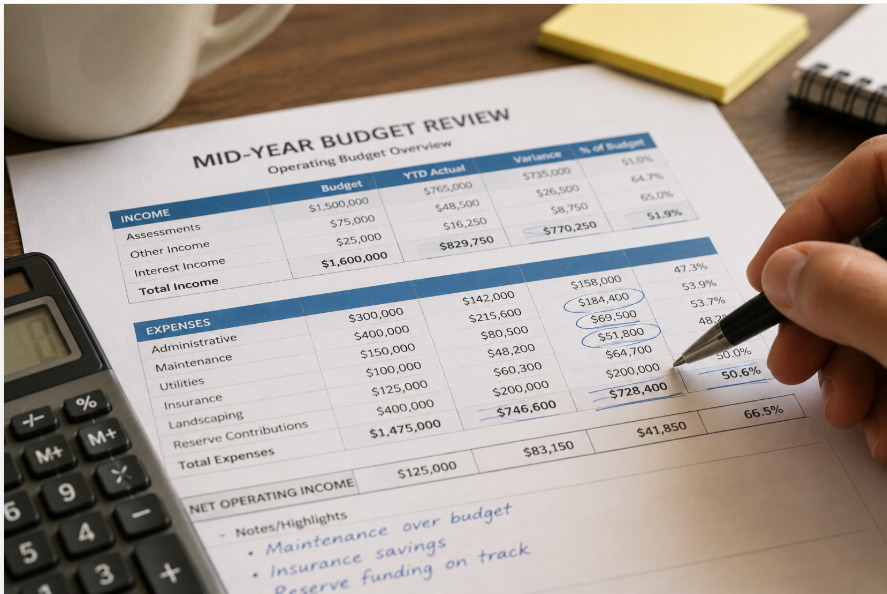
A mid-year financial review gives Minnesota HOA boards a clear picture of where the association stands against its approved budget at the halfway point of the fiscal year, creating time to course-correct before year-end pressures arrive. Boards should compare actual income and expenses against the budget, review reserve fund balances, flag any significant variances, and assess whether year-end projections still hold. July is the ideal time for this exercise because the major spring maintenance push is complete, summer expenses are underway, and there is still enough of the year remaining to take meaningful action if something is off track. This guide walks through each step of a practical mid-year financial check-in for Minnesota HOA boards.
Most HOA boards do the hard work of building a budget in the fall, approve it, and then largely move on. That budget gets revisited at monthly meetings when the financial reports come in, but a true mid-year review, the kind where the board sits down and asks whether the financial plan is still working, happens far less often than it should. July is the natural moment to do it.
Why July Is the Right Time for a Minnesota HOA Financial Review
Minnesota HOAs face a genuinely seasonal financial calendar. Snow removal and winter maintenance costs hit in the first quarter. Spring cleanup, landscaping startup, and deferred winter repairs land in the second quarter. By the time July arrives, boards have real data to work with, and that data tells a much more complete story than the Q1 numbers alone.
Summer also brings its own cost pressures: pool maintenance (where applicable), irrigation, landscaping contracts at peak frequency, and increased demand on common area amenities. Reviewing finances now means the board can see both what spring actually cost and whether summer is tracking as expected. For communities that had an unusually rough winter, the mid-year review often reveals that the maintenance line has already been stretched, which has implications for how the rest of the year should be managed. The broader picture of How Minnesota Weather Impacts HOA Budgets makes clear why this seasonal rhythm matters so much.
Step 1: Pull the Right Reports
A mid-year financial review isn’t productive without the right documents in front of the board. At minimum, you need:
- Budget vs. actual income and expense report for January through June (or your fiscal year equivalent)
- Balance sheet showing current assets, liabilities, and equity
- Reserve fund account statement reflecting current balance and recent activity
- Accounts receivable aging report showing any outstanding dues
- Bank reconciliations for the operating and reserve accounts
If your management company or treasurer isn’t routinely producing these reports, that is itself a finding worth addressing. Understanding HOA Financial Reports is a practical guide for boards who want to build stronger financial literacy across the whole board, not just the treasurer.
Step 2: Analyze the Budget vs. Actual
Go through each line item in your budget and compare it to actual year-to-date spending. You are looking for two things: lines that are significantly over budget and lines that are significantly under budget. Both matter.
Over-Budget Lines
Over-budget lines need an explanation. Was this a one-time event (emergency repair, unusually harsh spring) or a pattern that suggests your budget assumption was wrong? If it was a one-time event, note it and move on. If it suggests the annual budget figure is too low, that is information you need for the fall budgeting process, and it may also require a mid-year adjustment to how you allocate remaining funds.
Under-Budget Lines
Under-budget lines can feel like good news, and sometimes they are. But they can also signal deferred work. A landscaping line that is 30 percent under budget in July may mean a vendor is behind on contracted services, not that the community is saving money. Investigate before celebrating.
One common mistake we see is boards treating under-budget lines as savings that can be freely redirected. Sometimes the work simply hasn’t happened yet and will land in Q3 and Q4. Spending against a line that still has committed expenses coming is a fast way to end the year over budget.
Step 3: Review the Reserve Fund
The reserve fund review at mid-year is less about the current balance and more about trajectory. Compare your current balance to your reserve study’s projection for this point in the year, accounting for contributions received and expenditures made. Ask two questions:
- Are we contributing to reserves at the rate the reserve study requires?
- Have any reserve expenditures exceeded what was planned?
If either answer raises a concern, it feeds directly into the broader reserve fund health conversation. Our dedicated post on HOA Reserve Fund Health Checks for Minnesota Communities goes deeper on what the mid-year reserve picture should look like and what to do when it doesn’t.
Step 4: Review Accounts Receivable and Delinquency
Mid-year is a natural checkpoint for dues collection. Pull your accounts receivable aging report and look at:
- How many units are 30, 60, or 90-plus days past due?
- Has delinquency increased since the beginning of the year?
- Are there any units that have been delinquent for multiple consecutive months?
Delinquency that isn’t addressed tends to compound. If you are seeing elevated receivables at mid-year, now is the time to confirm your collection policy is being followed and to consider whether any accounts need to move to the next step in your enforcement process. The connection between delinquency and overall financial health is explored in depth in 5 Signs Your HOA Finances Are in Trouble and What Minnesota Boards Should Do About It.
Step 5: Update Your Year-End Projection
Once you have reviewed actuals and identified any significant variances, build a revised year-end projection. Take your actual spending through June, add your best estimate of the remaining six months by line item, and compare that total to your approved budget. This projection doesn’t need to be perfect, but it should give the board a reasonable estimate of whether you will finish the year on budget, over budget, or under budget.
If the projection shows a material overage, the board needs to decide now how to address it: reduce discretionary spending in the back half of the year, draw from operating reserves (if permitted), or, in more significant cases, assess a special assessment. None of those decisions gets easier by waiting.
A Real-World Scenario: The Irrigation System That Changed Everything
A Minneapolis-area HOA completed their mid-year review in July and noticed that their landscaping vendor line was tracking 22 percent over budget through June. The treasurer initially assumed it was a billing error. When the board dug in, they discovered the irrigation system had needed two significant repairs in the spring, both of which were billed under the landscaping contract but hadn’t been captured in the original budget because they were unexpected. The system was aging, and the vendor had flagged that a third repair was likely before fall. Without the mid-year review, the board would have learned about the budget impact in November, with no time to adjust. Instead, they moved a planned common area improvement to the following year’s budget and ended the year within 3 percent of plan.
The lesson: the mid-year review doesn’t just catch problems. It creates time to solve them.
Frequently Asked Questions
1. How often should a Minnesota HOA board review its finances?
Monthly financial reports should be reviewed at every board meeting, but a true mid-year review, where the board compares actuals to budget and builds a year-end projection, should happen at least once between the annual budget adoption and year-end. July is the natural time for this deeper review in most Minnesota communities.
2. What is the difference between a mid-year budget review and the monthly financial report review?
Monthly reports tell you what happened last month. A mid-year review steps back to look at the cumulative six-month picture, evaluates trends, and asks whether the annual budget is still on track. It also includes a forward-looking projection for the rest of the year, which monthly report reviews typically don’t address.
3. What should we do if we discover we’re significantly over budget at mid-year?
First, understand why. Is it a one-time event or a systemic budget error? Then assess your options: reduce discretionary spending for the remainder of the year, defer non-critical projects to next year, or, if the variance is large enough, consult your governing documents about whether a special assessment is necessary. Document the board’s decision and rationale.
4. Should homeowners receive a mid-year financial summary?
Communicating financial health to homeowners is good governance, even when the news is neutral. A brief mid-year financial update in the community newsletter or at a homeowner meeting builds trust and demonstrates transparency. It also creates an opportunity to explain any unusual expenses before homeowners hear about them through informal channels.
5. Can our property management company run the mid-year review for us?
Yes, and they should be a primary resource in this process. A good HOA management company will produce the reports, help the board interpret the numbers, flag variances, and support the year-end projection process. The board still needs to review and understand the findings, but you shouldn’t be doing the analytical work alone.
Final Thoughts
A July financial check-in isn’t extra work. It’s the kind of proactive oversight that separates boards that end the year in control from those that are constantly reacting. The data you already have at mid-year is valuable, and using it well is one of the clearest ways a board demonstrates that it is managing the community’s money responsibly.
EPMI supports Minnesota HOA boards through every step of the financial calendar, from monthly reporting to mid-year reviews to annual budget preparation. If your board would find it helpful to have a structured mid-year financial review process, we’d be glad to walk you through it.