
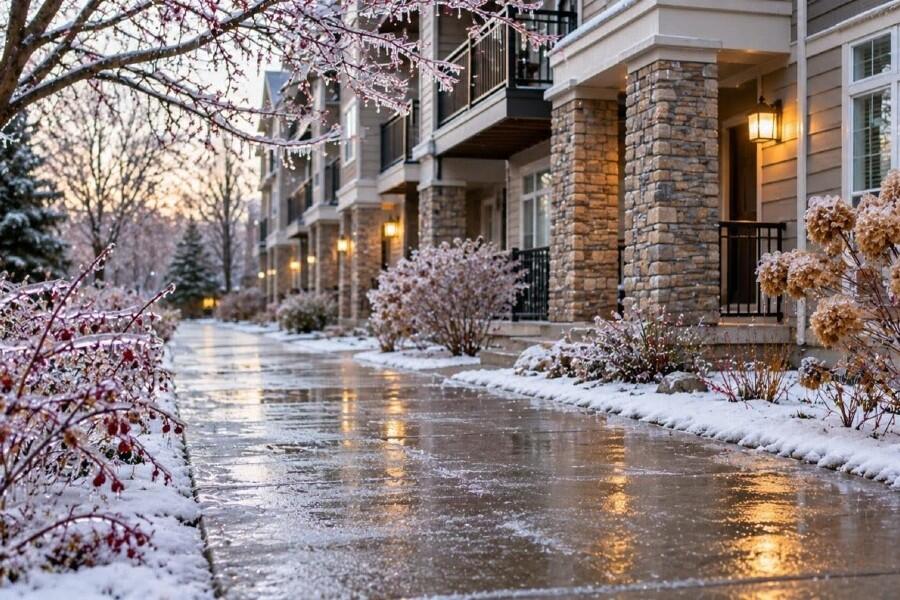
Quick answer for Minnesota HOA boards: Slip-and-fall risk is best managed by checking the declaration, mapping who maintains each surface, clarifying snow and ice service triggers, documenting responses, and promptly escalating incidents to the insurer. Liability is fact-specific, not automatic.
One overnight thaw, one sharp temperature drop, and the walkway that looked fine at 5 p.m. can become a skating rink by breakfast. In Minnesota, that is not a hypothetical winter problem. It is a routine challenge for townhouse and condominium associations.
The short answer: An HOA board should identify who is responsible for each walking surface, establish a reasonable inspection and response process, and keep records showing what was done. A slip-and-fall does not automatically mean the association is legally liable, but a poorly managed winter maintenance program can make a difficult situation worse.
Who Is Responsible for Ice Removal in a Minnesota HOA?
Start with the association’s declaration, maintenance provisions, vendor contract, and the location of the hazard. The association may be responsible for common sidewalks and private roads, while an owner may have assigned duties for steps, a driveway, or a limited common element.
For communities subject to Minnesota’s Common Interest Ownership Act, Minnesota Statutes § 515B.3-107 provides a starting framework for common-element maintenance, subject to the declaration and applicable provisions. The association’s legal duties and potential liability depend on the facts, not merely who holds the shovel.
The spots that cause the most confusion
- Shared sidewalks: Frequently maintained through the association’s snow and ice contract.
- Individual driveways: Responsibility varies by declaration and contract.
- Front steps and stoops: Often overlooked when contracts describe only sidewalks and roads.
- Mail kiosks and trash enclosures: High-traffic areas that need a clear inspection plan.
- Guest parking and paths to amenities: Lower-use areas still need an intentional maintenance decision.
Do not assume a contractor is covering every surface just because the proposal says “snow removal.”
What Does HOA Liability Actually Mean?
A person who falls may allege that a property owner or responsible party failed to use reasonable care. Whether a Minnesota association is legally responsible depends on issues such as the condition, notice of the hazard, the opportunity to respond, the maintenance arrangements, and the surrounding circumstances.
A fall is not proof of negligence. Equally, having a signed snow contract does not automatically eliminate the association’s exposure. Boards should rely on their insurance carrier and Minnesota legal counsel to evaluate an actual claim.
The practical goal is to show a consistent, reasonable process rather than a promise that no ice will ever exist.
Board takeaway: If your snow contract does not say who responds to freezing rain, runoff, and refreezing, your board has a gap worth fixing before the next cold snap. EPMI can help coordinate a practical site-specific winter maintenance workflow. See how our Minnesota HOA management team works.
Five Winter Controls That Make a Real Difference
1. Define the service areas before the first storm
Use a marked site map identifying roads, sidewalks, steps, ramps, mail areas, and other high-traffic surfaces. Note which areas are association-maintained, owner-maintained, or excluded.
2. Understand the trigger for service
Is plowing dispatched at two inches of snow? Is ice treatment a separate service? Does the vendor respond automatically to freezing rain or only when management calls? Get the answers in writing.
3. Plan for the freeze-thaw cycle
Twin Cities communities can experience daytime melting followed by overnight refreezing. A plowing threshold alone will not address black ice, downspout runoff, or shaded north-facing sidewalks.
4. Keep a practical paper trail
Save weather-related service logs, vendor tickets, inspection notes, homeowner reports, response times, and photos when appropriate. Documentation should reflect actual work performed, not a reconstructed story after an incident.
5. Tell residents how to report a hazard
Give homeowners one clear reporting channel and explain the emergency contact process. A report that lands in an unmonitored board member’s personal inbox is not a reliable winter safety system.
A Twin Cities Example: The Sidewalk That Refroze
Consider a fictional 48-unit townhome association in Woodbury. Snow was cleared on Monday morning. On Tuesday, sunshine melted snow piled beside a walkway. By Wednesday at 7 a.m., runoff had refrozen near the mailbox area.
The board’s first question should not be, “Didn’t we already pay for snow removal?” It should be, “Does our winter plan cover runoff and refreeze conditions, and who checks that location?”
The fix might involve ice treatment, redirecting drainage, relocating snow piles, or adjusting inspections. A recurring icy patch is often a maintenance problem, not just a weather problem.
What to Do If Someone Reports a Fall
- Address immediate hazards without waiting for a liability determination.
- Call emergency services if medical help is needed.
- Record the facts promptly: location, time, reported conditions, witnesses, and photographs where appropriate.
- Notify the association’s insurer and management company under applicable policy and reporting procedures.
- Preserve records such as service logs, video, communications, and the relevant contract.
- Avoid assigning blame or promising payment. Direct claim decisions to the insurer and appropriate professionals.
For broader seasonal preparation, see our winter HOA best practices for Minnesota communities and guide to managing underperforming HOA vendors.
Related Reading for Minnesota HOA Boards
- Minnesota HOA snow removal responsibilities: A practical companion for the next board discussion.
- winter HOA best practices: Additional guidance to help apply this article to your community.
- what to do when HOA vendors are not performing: A practical companion for the next board discussion.
- Minnesota weather and HOA budgets: Additional guidance to help apply this article to your community.
These articles cover related questions without repeating the focus of this guide.
What to Do Next
At the next board meeting, review the snow contract alongside a map of the property. Identify service gaps, confirm who monitors refreezing, and establish one process for reporting and documenting hazards. Review the association’s liability coverage with its insurance agent as well.
EPMI helps Minnesota townhouse and condominium boards coordinate vendors, maintain records, and build workable seasonal maintenance processes. Explore professional HOA management with Exclusive Property Management Inc. or browse our HOA board resources.
Need a winter maintenance process your board can actually oversee? EPMI helps Minnesota townhouse and condominium associations coordinate vendors, clarify responsibilities, and organize records. Contact Exclusive Property Management Inc. to discuss your association’s needs.
Frequently Asked Questions
Is a Minnesota HOA automatically liable when someone slips on ice?
No. Liability depends on the specific facts and applicable law. A fall alone does not establish negligence.
Does hiring a snow contractor transfer all liability to the contractor?
Not automatically. Contract terms, the association’s duties, and the circumstances matter. The association should maintain oversight and review insurance and indemnification provisions with appropriate professionals.
Can the HOA require owners to shovel their own steps?
Possibly, depending on the declaration, rules, and applicable law. Boards should verify the assignment of responsibility before enforcing it.
Should the board document every snow event?
A consistent service and incident record is valuable. The level of detail should be proportionate to the community and the risks.
What is the most overlooked winter hazard?
Refreezing runoff near downspouts, mailboxes, ramps, and shaded walkways is easy to miss when a contract focuses only on snowfall totals.
Educational information only; not legal or insurance advice.
Editorial trust note: This is general education for Minnesota community associations. Confirm current legal, insurance, and tax requirements with the appropriate professional before taking action.