
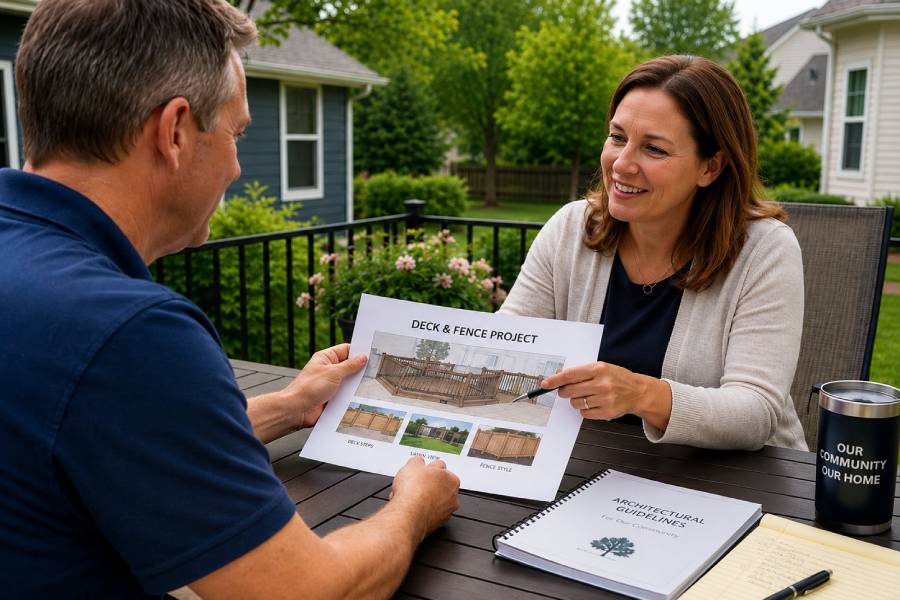
An HOA architectural review committee in Minnesota is a board-appointed group responsible for reviewing homeowner requests to make exterior modifications to their property and ensuring those changes meet the community’s established design standards. A well-structured committee protects property values, keeps decision-making consistent, and reduces the burden on the full board.
Spring is when the deck projects, fence installations, and driveway replacements begin in Minnesota. A homeowner who spent the winter planning a backyard addition is ready to move fast the moment the frost leaves the ground, and they expect a timely answer from the association. Boards that do not have a defined architectural review process will find themselves fielding these requests on an ad hoc basis, making inconsistent decisions, and sometimes discovering after the fact that an unapproved modification was already half-finished.
Why Minnesota HOAs Need an Architectural Review Process
The authority to regulate exterior modifications in an HOA community typically comes from the Declaration or CC&Rs. Most governing documents include language prohibiting exterior changes without prior written approval and authorizing the board to establish standards for what will and will not be approved.
The architectural review process is how that authority gets exercised in practice. Without it, a few predictable problems arise:
- The full board spends meeting time reviewing individual modification requests that a smaller committee could handle
- Decisions are made inconsistently depending on who is reviewing, creating grounds for homeowners to challenge approvals or denials
- The community ends up with a patchwork of exterior modifications that affect visual consistency and, over time, property values
- Homeowners who did not get approval may claim they did not know the process, creating enforcement complications
The legal and governance backdrop matters here. Minnesota HOA laws every board should know establish the framework within which your committee must operate, including requirements around notice, hearing rights, and procedural fairness when a request is denied.
What an Architectural Review Committee Does
An architectural review committee (sometimes called an ARC or ACC) serves as the first point of contact for homeowner modification requests. Its core functions are:
- Receiving and logging modification requests
- Reviewing applications against the community’s design standards or architectural guidelines
- Conducting site visits when relevant
- Approving, conditionally approving, or denying requests within a defined timeline
- Documenting decisions and communicating them to the applicant in writing
- Escalating unusual or contested situations to the full board
The committee does not set policy. It applies existing policy. The board adopts the architectural guidelines and the review process; the committee executes that process.
How to Set Up an ARC: Step by Step
Step One: Confirm Your Governing Documents Authorize It
Before appointing anyone to a committee, confirm that your Declaration or bylaws authorize the board to establish an architectural review process and delegate that authority to a committee. Most Minnesota HOA governing documents include this authority, but you should verify before proceeding.
If your documents are silent on the matter, consult with an HOA attorney about whether a board resolution or rule adoption is sufficient to establish the committee, or whether a governing document amendment is needed.
Step Two: Adopt Written Architectural Guidelines
A committee is only as useful as the standards it applies. Written architectural guidelines should describe, in measurable terms:
- What types of modifications require prior approval (decks, fences, landscaping changes, exterior paint or siding, windows, doors, driveways, outbuildings, solar panels, and so on)
- What types of modifications are pre-approved without requiring review (minor repairs using like materials, for example)
- What information is required in a modification request (site plans, materials specifications, contractor information, timeline)
- Design standards the community has adopted (approved fencing materials and heights, deck railing styles consistent with community character, approved exterior colors or siding types)
- The timeline within which the committee will respond, and what happens if the deadline passes without a decision
Getting specific is essential. As we discuss in our post on why clear HOA rules actually make communities better, vague standards invite disputes. If your guidelines say fences must be “aesthetically appropriate,” every denial becomes an argument. If they say fences must be cedar, pine, or vinyl in approved colors, at a maximum height of six feet, with no chain-link or wire materials, the committee is applying an objective standard.
Step Three: Appoint Committee Members
Committee members are typically volunteers from the community who are appointed by the board. Best practices for composition include:
- Three to five members is a workable size for most communities
- At least one board member may serve as a liaison, but the full board should not constitute the committee
- Members should have no conflict of interest with any application they review
- Staggered terms help maintain continuity as members cycle off
One common mistake is appointing committee members informally or verbally without documenting the appointment. All committee appointments should be memorialized in board meeting minutes so there is a clear record of who has authority to act on the committee’s behalf.
Understanding HOA board member responsibilities is directly relevant here because committee members, like board members, have a duty to act in the best interest of the community and apply standards without favoritism.
Step Four: Establish a Review Process and Timeline
The review process should be documented and communicated to all homeowners. A standard process might look like this:
- Homeowner submits a completed application with all required documentation
- Committee acknowledges receipt within a specified number of days
- Committee reviews the application, conducts a site visit if necessary, and reaches a decision
- Decision is communicated to the homeowner in writing within the established timeline (30 days is common; some governing documents specify a default approval if no response is given within the deadline, so check yours)
- If the request is denied or conditionally approved, the written decision states the specific reason with a citation to the relevant guideline
Timeliness matters more than many boards realize. A homeowner who submitted an application in April and has not heard back by June will either proceed without approval or become a source of board meeting complaints. A committee that responds promptly, even with a denial, builds credibility.
Step Five: Communicate the Process to Homeowners
A process that homeowners do not know about will not be followed. Before the spring modification season begins, send the community a reminder of the architectural guidelines and instructions for submitting a modification request. Include a link to the application form. Make it easy to find on your community portal or website.
This communication is also an opportunity to remind homeowners that starting a project without approval creates complications for everyone. A partially completed unapproved modification is harder to address than a request submitted before work begins, as discussed in our overview of common HOA maintenance mistakes and the enforcement problems that result from unclear procedures.
What Happens When a Request Is Denied
Denial is the situation where a well-designed process matters most. A homeowner who receives a denial without a specific reason or a clear explanation of the governing standard will almost certainly push back, and may have grounds to do so if the decision appears arbitrary.
Best practices for handling denials include:
- Always state the denial in writing
- Cite the specific guideline or standard the request does not meet
- Where possible, explain what modification would be approvable (for example, “a cedar or vinyl fence at the requested location would be approved; the proposed chain-link material does not meet Section 4.3 of the architectural guidelines”)
- Include information on the homeowner’s right to appeal, if your governing documents provide for one
A denial that follows this format is defensible. A denial that says “your request does not fit the character of the community” without further explanation is an invitation to dispute.
A Real-World Scenario: The Deck Built Without Approval
A homeowner in a planned unit development in the southern Twin Cities area submitted a rough sketch of a proposed deck by email, received no response within two weeks, and proceeded on the assumption that silence meant approval. The deck was completed before the committee had even discussed the request. The resulting deck did not comply with the community’s height restriction for elevated structures and was visible from several neighboring units.
The board faced a difficult choice: require the homeowner to remove or modify a completed structure, or accept the noncompliant modification and set a precedent that silence equals approval. The situation required legal consultation and resulted in a negotiated resolution that cost the association time and homeowner goodwill.
The fix was twofold: the committee established a formal acknowledgment protocol so that every application received a written response within five business days confirming receipt and the review timeline, and the architectural guidelines were updated to explicitly state that the absence of a response does not constitute approval. Neither change was complicated. Both would have prevented the situation entirely.
How Professional Management Supports the ARC Process
Many Minnesota HOA communities work with a professional management company to administer the architectural review process. This typically means the management company receives applications, logs them, distributes them to the committee, tracks deadlines, and sends written decisions on behalf of the committee. The committee still makes the substantive decisions; the management company handles the administrative workflow.
This arrangement benefits smaller communities where volunteer bandwidth is limited and where having a neutral administrative party helps keep the process from feeling personal. How professional HOA management helps protect property values explores the broader role that consistent standards enforcement plays in maintaining a community’s long-term value.
Frequently Asked Questions
1. Does every Minnesota HOA need an architectural review committee?
Not every association needs a formal standing committee. Smaller communities may handle modification requests through a board subcommittee or by delegating review to the full board. What every community with exterior modification standards needs is a documented process, written guidelines, and consistent application. Whether that is managed by a committee, a subcommittee, or the full board depends on the community’s size and governance capacity.
2. How long does the HOA have to respond to an architectural modification request in Minnesota?
Response timelines should be specified in your architectural guidelines or governing documents. Many communities use 30 days as a standard review period. Some governing documents include a default approval provision if the committee fails to respond within the specified period, which makes timely responses essential. If your documents are silent on the timeline, the committee should adopt one in its written procedures.
3. Can a Minnesota HOA deny a request for solar panels?
Minnesota has statutory protections for homeowners who want to install solar energy systems. The HOA can impose reasonable restrictions on the placement and aesthetics of solar installations but cannot effectively prohibit them or impose conditions that make installation impractical. Boards considering a denial or significant conditions on a solar panel request should consult with legal counsel to confirm compliance with state law.
4. What should happen if a homeowner builds a modification without approval?
Your governing documents typically authorize the board to require removal of an unapproved modification, require the homeowner to submit a retroactive application (which the committee then reviews against existing standards), or impose fines for the violation. The approach depends on what the modification is, whether it could be approved if properly submitted, and whether it poses any safety or compliance concern. Acting promptly is important; delay signals that unapproved modifications are acceptable.
5. Can a committee member be removed if they have a conflict of interest?
Yes. Committee members should recuse themselves from any review where they have a personal interest in the outcome, such as if the applicant is a close friend, neighbor in an adjacent unit, or business associate. A recusal policy should be included in the committee’s written procedures. If a committee member consistently fails to recuse appropriately, the board has authority to remove and replace them.
Final Thoughts
An architectural review committee is one of the most practical tools a Minnesota HOA board has for protecting community standards over the long term. When it is set up thoughtfully, with written guidelines, a defined process, and trained volunteers who apply standards consistently, it takes significant pressure off the full board and gives homeowners a clear, fair path for making exterior improvements.
The spring modification season does not wait for boards to get organized. If your community is heading into May without a defined review process or updated architectural guidelines, this is the right time to address it. EPMI works with Minnesota HOA boards to build the governance structures that make communities run more smoothly and last longer. We are glad to be a resource as you think through what your community needs.