
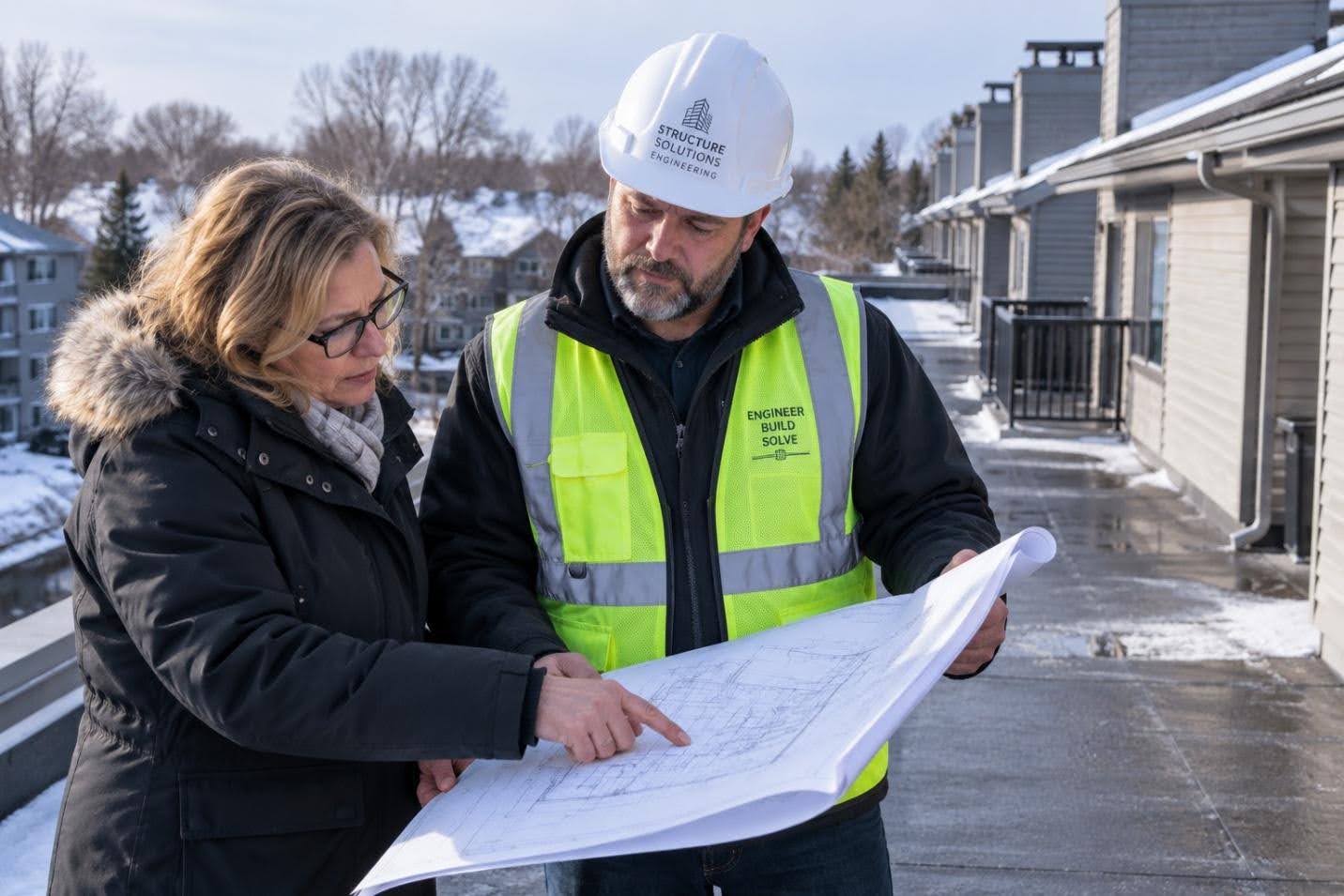
Minnesota HOA boards should hire a licensed engineer — rather than going directly to a contractor — when a repair or project involves structural components, life-safety systems, significant capital expenditure, or any situation where an independent professional assessment is needed to protect the association from liability. Engineers diagnose root causes and produce specifications; contractors execute work based on those specifications. Skipping the engineering step on the wrong project can cost an association far more in the long run.
Most board members got involved in their HOA because they care about their community, not because they have a background in construction or facilities management. That makes the engineer-versus-contractor question genuinely difficult — and genuinely consequential. Get it wrong in one direction and you overspend on professional fees for a simple fix. Get it wrong in the other direction and you approve a $180,000 parking lot repair that addresses the symptom but not the underlying drainage failure causing it.
Why This Decision Matters More Than Most Boards Realize
In Minnesota, HOA boards have a fiduciary duty to the membership. That duty includes making informed decisions about how association funds are spent on common area maintenance and capital repairs. When a board hires a contractor to assess and then repair a problem the contractor identified, there is an inherent conflict of interest — the contractor has a financial incentive to recommend work, and no independent obligation to consider whether a different approach might serve the association better.
A licensed professional engineer (PE) in Minnesota carries statutory obligations that a contractor does not. Engineers are bound by the Minnesota Board of Architecture, Engineering, Land Surveying, Landscape Architecture, Geoscience and Interior Design (AELSLAGID) to produce work that meets professional standards of care. When an engineer seals a report or a set of drawings, that document carries legal weight that a contractor’s proposal simply does not.
The Root Cause Problem
One common mistake boards make is treating visible damage as the problem, when the visible damage is actually a symptom. A contractor called in to repair a cracked concrete retaining wall will typically price out the repair of that wall. A structural engineer will assess why the wall cracked — whether it is hydrostatic pressure from poor drainage, soil movement, inadequate original design, or frost heave — and specify a repair that addresses the actual cause. In Minnesota’s climate, where freeze-thaw cycles are severe and soil conditions vary significantly across the metro and outstate regions, that distinction can mean the difference between a lasting repair and the same problem returning in three years.
Situations Where Minnesota HOAs Should Always Hire an Engineer First
Some project categories carry enough complexity, liability exposure, or capital risk that bringing in an engineer before soliciting contractor bids is simply best practice.
Structural assessments of any kind. If a board has questions about the integrity of a building’s structure — load-bearing walls, foundations, parking decks, elevated walkways, balconies, or roofing systems — a structural engineer should assess the condition before any contractor touches the work. This is especially true in older Minnesota condominium buildings where original construction documents may be incomplete or unavailable.
Significant water intrusion or drainage failures. Water is the most destructive force in Minnesota buildings and common areas. When water infiltration is recurring or widespread, a civil or geotechnical engineer can identify the drainage, grading, or waterproofing failure driving the problem. Contractors may address visible wet spots; engineers trace water to its source.
Retaining walls over four feet in height. Under Minnesota building code, retaining walls exceeding four feet in height generally require engineered design. If an HOA’s existing retaining wall is failing and it meets that threshold, engineering involvement is not optional — it is a code requirement.
Pavement and parking lot failures with drainage involvement. A parking lot that is alligatoring, heaving, or holding standing water may need more than mill-and-overlay. A civil engineer can assess subgrade conditions and drainage design before the board commits significant reserve funds to a surface repair that will fail again if the underlying issue is not corrected.
Any project where the board plans to seek competitive bids. Engineers produce specifications that allow apples-to-apples contractor bids. Without specifications, boards often receive proposals that are incomparable — different scopes, different materials, different assumptions — making it nearly impossible to evaluate bids fairly or protect the association if a contractor’s work falls short.
Reserve study-driven capital projects. When a project is large enough to appear in the association’s reserve study, it is large enough to warrant engineering oversight. An engineer can verify that the reserve study’s cost estimate and scope assumptions are still accurate before the board commits funds.
When a Contractor Alone Is Appropriate
Not every maintenance task requires engineering involvement, and boards should not over-engineer routine work. Contractors working within their licensed scope are the right choice for clearly defined, bounded repairs where the cause is obvious and the solution is standard.
Painting and staining common area surfaces, replacing gutters and downspouts, repairing or replacing fencing, standard HVAC servicing, landscaping and irrigation work, and replacing like-for-like fixtures are all examples of projects where a qualified licensed contractor is the appropriate professional. The key question is whether independent diagnosis and specification are needed, or whether the scope is already clear.
A Real-World Scenario: The Parking Deck That Almost Got Patched
A mid-size condominium association in the western Twin Cities suburbs noticed cracking and surface deterioration across roughly 30 percent of their upper parking deck. The board obtained two contractor bids for crack injection and surface coating. Both bids came in under $40,000, and the board was prepared to approve the work at their September meeting.
Before the vote, one board member — a retired contractor himself — asked whether anyone had looked at the structural deck below the surface. The board engaged a structural engineer at a cost of approximately $4,500. The engineer’s report found that the cracking was the result of failed waterproofing membrane below the surface coating, and that water had been infiltrating the structural slab for several years, causing corrosion to the post-tensioned cables inside. The actual repair required partial slab replacement and full membrane replacement at a cost significantly higher than the original bids — but the engineer’s report also confirmed that the two contractor proposals would have failed within two to three years and potentially masked ongoing structural deterioration.
The lesson is straightforward: the $4,500 engineering assessment cost the board a harder conversation and a larger project, but it prevented the association from spending $40,000 on a repair that would have made the eventual structural repair more expensive and more disruptive.
How to Work With an Engineer as an HOA Board
Boards that have not worked with engineers before sometimes find the process unfamiliar. A few practical points help.
Hire the engineer before you talk to contractors. The sequence matters. An engineer hired after contractor bids have already been received may feel implicitly or explicitly pressured to validate work that is already in motion. Bring the engineer in first, let them assess and specify, then bid the work.
Ask the engineer to attend the contractor bid opening or review bids alongside the board. Some engineers offer bid review as part of their scope and can flag whether contractor proposals are responsive to the specifications. This service is often worth the additional fee.
Make sure the engineer’s scope includes construction observation if the project is significant. Having the engineer make periodic site visits during construction — to verify that work is being performed per the specifications — closes the loop and gives the board documentation that work was performed correctly.
Minnesota HOA boards can also ask their HOA management company to help coordinate the engineering engagement. An experienced management company will have working relationships with engineers who have done condominium and HOA work specifically, which is a different practice area than residential or commercial new construction.
What Engineers Cost and How to Budget for It
Engineering fees vary by project scope and complexity, but Minnesota HOA boards should expect professional engineering assessments to range from roughly $2,500 for a targeted single-component assessment to $15,000 or more for a comprehensive building envelope study or parking structure evaluation. For large capital projects, engineering fees of two to five percent of total project cost are a reasonable benchmark.
These fees should be considered an operating or reserve expense depending on the nature of the project. For reserve-funded capital projects, engineering costs are often already contemplated in the reserve study. Boards working with a professional HOA management company can get guidance on how to categorize and budget these fees appropriately within the association’s financial structure.
One common mistake is treating engineering fees as a cost to be avoided rather than a form of risk management. A $5,000 engineering report that prevents a $60,000 misdiagnosed repair is not an expense — it is a return on fiduciary responsibility.
Frequently Asked Questions
1. Does a Minnesota HOA legally need an engineer for structural repairs?I
In some cases, yes. Minnesota building code requires licensed engineer involvement for certain structural work, including retaining walls over four feet in height and any repair or modification to structural systems in buildings requiring a building permit. Beyond code requirements, engineering involvement is a best practice for any project where structural integrity or significant reserve funds are at stake.
2. Can a contractor provide an engineering assessment?
No. Only a licensed professional engineer (PE) registered in Minnesota can provide a formal engineering assessment or seal engineering documents. Some contractors have engineering backgrounds, but unless they hold an active PE license in Minnesota, their assessment does not carry the same legal weight or professional liability as a licensed engineer’s report.
3. How do we find a qualified engineer for HOA work in Minnesota?
Look for engineers with specific experience in multi-family residential or condominium building assessments. The Minnesota chapter of the Community Associations Institute (CAI-MN) maintains vendor directories, and experienced HOA management companies typically have established relationships with engineers who specialize in this sector. Ask any candidate for references from comparable association projects.
4. What is the difference between a reserve study and an engineering assessment?
A reserve study estimates the remaining useful life and replacement costs of common components for financial planning purposes. An engineering assessment evaluates the current condition of a specific component in detail, diagnoses problems, and produces repair specifications. Reserve studies inform budgeting; engineering assessments inform specific repair decisions. Both are valuable tools, and findings from an engineering assessment may warrant updating the reserve study.
5. Should the engineer or the contractor be in charge of a repair project?
The engineer specifies and oversees; the contractor executes. On significant projects, the engineer’s role continues through construction observation — verifying that the contractor is performing work in accordance with the specifications. The contractor is responsible for means, methods, and workmanship. Keeping those roles clearly separated protects the association if disputes arise about the quality or adequacy of completed work.
Final Thoughts
The engineer-versus-contractor question does not have a single answer that applies to every situation, but it does have a clear framework: when diagnosis, specification, or independent professional judgment is needed, bring in a licensed engineer before committing to any contractor work. When the scope is clear, bounded, and within a contractor’s licensed practice, proceed accordingly.
Minnesota HOA boards are stewards of significant shared assets, and the decisions made about common area maintenance and capital repairs have lasting consequences for property values, safety, and association finances. EPMI works with communities across Minnesota to help boards navigate exactly these kinds of decisions — connecting them with the right professionals at the right time and ensuring that reserve funds are spent wisely. If your board is facing a repair decision and is not sure whether engineering involvement is warranted, that conversation is a good place to start.