
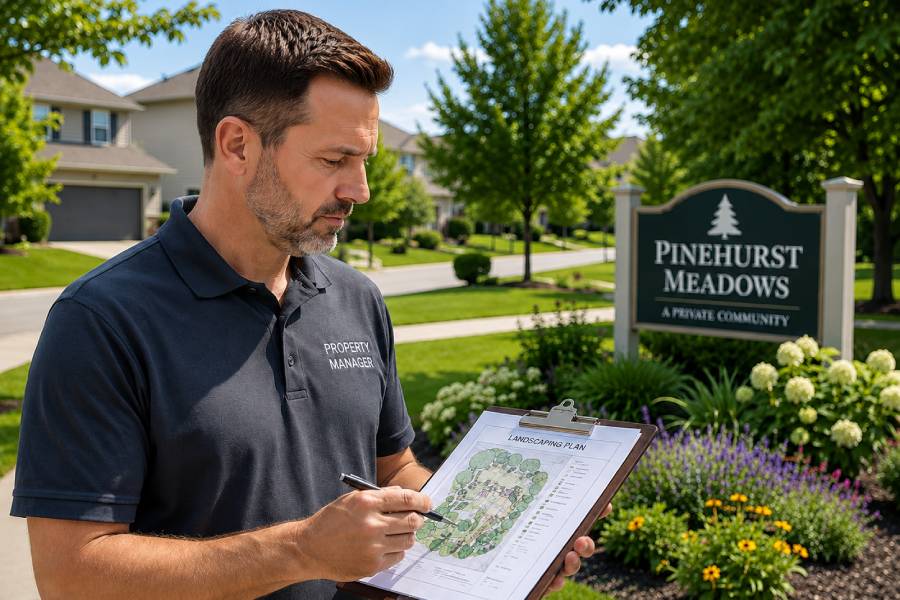
HOA landscaping rules in Minnesota define which areas the association maintains, what homeowners are responsible for, and what standards apply to plantings, lawn care, and exterior upkeep. Clear rules reduce conflict between neighbors, protect property values, and give boards a consistent framework for addressing complaints before they escalate.
May arrives in Minnesota and something predictable happens: the snow is gone, the ground is thawing, and homeowners are outside doing things. Some of those things are welcome. Others prompt a call to the management office before the lilacs have even finished blooming. Landscaping is one of the most visible and emotionally charged areas of HOA life, and boards that have not thought through their rules in writing will find this season particularly exhausting.
Why Landscaping Rules Matter More in Minnesota Than in Most States
Minnesota’s climate puts unusual pressure on HOA landscaping policies. A growing season that runs roughly from mid-May through September means that most of the year’s exterior activity is compressed into a short window. Add spring snowmelt that can reveal months of damage, freeze-thaw cycles that heave pavement and crack curbs, and the reality that turf recovery from a harsh winter can take weeks, and you have a situation where poorly defined rules create friction fast.
When boards are clear about who is responsible for what and what standards apply, homeowners know what is expected before they pick up a shovel. When those rules are vague or unwritten, the board ends up making inconsistent calls and homeowners feel they are being treated arbitrarily.
Understanding Minnesota HOA laws every board should know is a useful starting point, because your authority to enforce landscaping standards flows directly from your governing documents and the statutes that back them up.
The Stakes: Property Values and Community Relationships
Landscaping is one of the first things a prospective buyer or visitor notices about a community. A neighborhood where lawns are maintained consistently and common areas are well-kept signals that the association is functional and financially healthy. The reverse is also true.
Beyond aesthetics, disputes over landscaping are among the most common sources of neighbor conflict in HOA communities. Overhanging trees, poorly placed plantings that block sightlines, or a homeowner who lets their lawn go unmowed for three weeks can all generate complaints that consume board time and community goodwill.
Association Responsibilities vs. Homeowner Responsibilities
One of the most important things a board can do is draw a clear, written line between what the association maintains and what falls to individual homeowners. The specifics vary by community type, but here is a general framework.
What the Association Typically Maintains
In most Minnesota HOA communities, particularly townhome and condominium associations, the association handles:
- Common area turf and plantings (entrance monuments, pocket parks, retention ponds, shared green spaces)
- Irrigation systems serving common areas
- Street trees and boulevard plantings where the association owns or maintains the right-of-way
- Snow removal from shared driveways, walkways, and parking areas (which runs directly into landscaping prep and fall cleanup)
What Homeowners Are Typically Responsible For
In planned unit developments and single-family HOA communities, homeowners often handle:
- Lawn mowing and edging within their lot lines
- Watering and fertilizing their own turf
- Maintaining plantings in their private yards
- Removing dead or diseased trees within their lot
- Keeping beds free of weeds during the growing season
The critical mistake we see regularly is an association that has never formally documented this division and instead relies on informal understandings or a decades-old precedent that nobody wrote down. When a dispute arises, there is no document to point to, and the board is left improvising.
Reviewing common HOA maintenance mistakes and how Minnesota communities can avoid them is worth your time if your association has not recently audited whether your maintenance responsibilities are clearly defined in your governing documents.
Writing Landscaping Standards That Actually Work
A landscaping policy that holds up over time is specific, measurable, and fairly applied. Vague language like “yards must be kept neat and tidy” creates enforcement problems because it is entirely subjective. A homeowner who receives a violation notice for a lawn they consider perfectly acceptable will argue that “neat and tidy” is in the eye of the beholder. They are not entirely wrong.
Stronger policies use measurable language:
- Maximum grass height before a violation notice is issued (many Minnesota communities use 6 inches as the trigger)
- Required timing for spring cleanup (debris and dead material removed by a specific date each year, or within a specified number of days after the last frost date)
- Rules on approved and prohibited plant species, particularly invasive species that Minnesota has regulatory guidance on
- Standards for tree and shrub trimming, including clearance requirements near structures, walkways, or sightlines
- Mulch and edging requirements for planting beds
Handling Seasonal Transitions
Minnesota boards need landscaping policies that acknowledge the realities of the growing season. A rule requiring lawns to be mowed to a maximum height year-round does not account for the fact that May turf recovery after a hard winter can look rough even when the homeowner is doing everything right.
Consider building seasonal flexibility into your policy. A first-mowing grace period in May, a watering restriction acknowledgment during drought advisories, and a fall cleanup deadline tied to a realistic date (rather than a fixed calendar date that might fall before leaves are done dropping) all make your policy more defensible and easier for homeowners to comply with.
This intersects with budget planning, too. As noted in our post on how Minnesota weather impacts HOA budgets, unplanned landscaping expenses are one of the most common causes of mid-year budget stress. A proactive policy that addresses seasonal maintenance needs can reduce emergency spending.
Vendor Management and Landscaping Contracts
Most HOA communities in Minnesota contract out common area landscaping to a vendor. The quality of that contract determines a great deal about how the season goes. A landscaping contract should specify:
- Visit frequency (number of mowing visits per season, not just “as needed”)
- Scope of each visit (mow, edge, blow, trim)
- Seasonal services included or excluded (spring cleanup, fall leaf removal, mulching, overseeding)
- Response time for weather-related events or complaints
- What constitutes grounds for a contract modification or termination
Understanding what to do when HOA vendors aren’t performing is essential reading for any board entering a new landscaping season, because underperforming landscaping vendors are one of the most common complaints boards receive from homeowners.
Enforcing Landscaping Rules Fairly
Enforcement is where many well-intentioned landscaping policies break down. The most common failure mode is selective enforcement, where the board addresses violations from homeowners it has tension with while overlooking identical situations elsewhere in the community. This is both a legal risk and a community trust problem.
A consistent enforcement process typically looks like this: a documented inspection or complaint, a courtesy notice with a cure period, a formal violation notice if the issue is not resolved, and a fine schedule applied uniformly. The key word is uniformly. If your board would not send the same notice to every homeowner with the same condition, it should not send it to any of them.
As described in our post on why clear HOA rules actually make communities better, the goal of rules is not to give boards power over homeowners. It is to create a shared standard that makes the community function better for everyone.
HOA board member responsibilities include a duty to apply rules consistently, and landscaping enforcement is one of the areas where inconsistency most quickly damages board credibility.
Frequently Asked Questions
1. Who is responsible for landscaping in a Minnesota HOA?
Responsibility depends on your governing documents. In townhome and condo associations, the association typically maintains common areas and sometimes limited common elements adjacent to each unit. In single-family HOA communities, homeowners generally maintain their own lots. Every association should have this division documented in writing, ideally in both the declaration and a separate landscaping policy.
2. Can an HOA in Minnesota fine a homeowner for not mowing their lawn?
Yes, if the governing documents include a landscaping standard and the association follows its own enforcement process. That process must include proper notice and a reasonable opportunity to cure the violation before fines are assessed. Boards should apply fines consistently across all homeowners to avoid selective enforcement claims.
3. What invasive plants should Minnesota HOA boards be aware of?
Minnesota has state-regulated invasive species that associations should prohibit in community plantings. Buckthorn and garlic mustard are among the most common concerns in residential landscapes. The Minnesota Department of Natural Resources publishes a current list of terrestrial invasive species, and boards should consult that list when reviewing landscaping plans or vendor planting choices.
4. How should a Minnesota HOA handle tree disputes between homeowners?
Overhanging branches and tree roots that cross property lines are a perennial source of disputes in HOA communities. Your governing documents will typically govern who owns and is responsible for trees. When a tree is in a common area, the association is generally responsible. When a tree is on a homeowner’s lot but affects a neighbor, the board’s role is usually to enforce its landscaping and nuisance policies rather than adjudicate the private dispute directly.
5. Does the association need a written landscaping policy, or do the CC&Rs cover it?
CC&Rs and declarations typically establish the authority to maintain standards and enforce them, but they rarely include the specific details needed for consistent enforcement. A separate landscaping policy or set of rules and regulations adopted by the board gives you the measurable standards, seasonal timelines, and procedural steps that make enforcement defensible. It is also easier to update as conditions change without requiring a full amendment to your governing documents.
Final Thoughts
Landscaping is one of those HOA responsibilities that looks simple from the outside but creates real complexity in practice, especially in a state where the growing season is short and every homeowner is eager to get outside after a Minnesota winter. Boards that take the time to document responsibilities clearly, write standards in measurable language, and enforce rules consistently will spend far less time managing complaints and far more time enjoying the results.
If your association is heading into the season without clear landscaping rules or with a vendor contract that needs attention, EPMI works with Minnesota HOA boards to build the policies and processes that make communities run smoothly. We are always glad to talk through what that looks like for your specific community.