
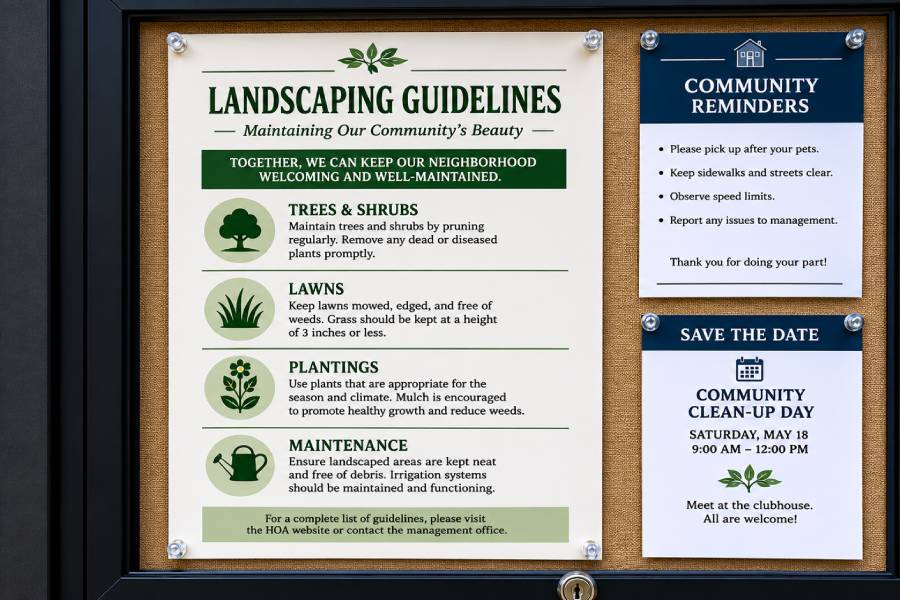
Minnesota’s short growing season makes landscaping a bigger source of HOA tension than boards often expect. Clear, enforceable landscaping rules protect property values, reduce neighbor disputes, and give your board the authority to act when something is genuinely out of hand.
There is something almost predictable about late May in Minnesota HOA management: the snow melts, the grass comes back, and the complaints start arriving. After months of frozen ground and quiet streets, homeowners suddenly notice the overgrown hedge next door, the yard that never got raked out, or the garden bed that has turned into something closer to a wildlife preserve. If your association does not have clear landscaping rules in place before the growing season kicks in, your board is already playing catch-up.
Why Landscaping Rules Matter More Than Boards Realize
Landscaping is one of the most visible aspects of any community. A single neglected yard on a block of otherwise well-kept homes affects how buyers, appraisers, and neighbors perceive the entire association. Professional HOA management helps protect property values in part by making sure the physical appearance of the community is consistently maintained, and landscaping sits right at the center of that effort.
Beyond property values, landscaping rules reduce conflict. When the standards are written down and applied consistently, homeowners know what is expected of them and what to do if a neighbor falls short. Without written standards, every enforcement conversation becomes a personal disagreement instead of a policy matter.
What Minnesota’s Climate Adds to the Picture
Minnesota’s climate creates landscaping challenges that do not exist in warmer states. The ground freezes hard, which means spring cleanup often reveals months of accumulated damage. Freeze-thaw cycles crack pavement edging and heave up landscaping bricks. Heavy snowfall flattens ornamental grasses and shrubs. A fair set of HOA landscaping rules for a Minnesota community should account for these seasonal realities rather than holding homeowners to a standard that ignores what winter does to a yard.
It is also worth noting that Minnesota’s growing season runs roughly from late April through mid-October, depending on the year. Rules that specify mowing frequency or lawn height should reflect the fact that grass grows at very different rates in June versus August, and that a homeowner who misses one mowing during a wet stretch in early summer may not be neglecting their property so much as falling a week behind in a demanding season.
What Landscaping Rules Typically Cover
Most HOA governing documents give the association authority to regulate the exterior appearance of properties, which includes landscaping. The specifics vary by association, but common areas of regulation include the following.
Lawn Maintenance Standards
Boards frequently set a maximum grass height, often somewhere between six and eight inches, before enforcement action begins. This gives homeowners a clear, measurable standard and removes the subjective question of whether a lawn “looks bad.” Rules may also address dead patches, bare spots, or visible weeds, though enforcement on those tends to be more discretionary.
We often see boards get into trouble when their rules say something like “lawns must be kept neat and tidy” without defining what that means. When a complaint comes in and the board tries to enforce based on that language, the homeowner pushes back because “neat and tidy” is a judgment call. Specific, measurable standards hold up far better.
Trees, Shrubs, and Garden Beds
Rules governing trees and shrubs often address height limits, especially for plantings near property lines or common areas, trimming requirements for branches that overhang walkways or neighboring units, and prohibitions on certain invasive species. Garden beds may be regulated for size, placement, or the types of plants allowed.
This is an area where Minnesota-specific rules make sense. Certain plants that look harmless in a garden center are classified as invasive in Minnesota, including Japanese barberry, buckthorn, and a handful of others. An HOA that explicitly prohibits invasive species is not just being aesthetic; it is protecting the surrounding landscape from a real ecological problem.
Exterior Improvements Requiring Approval
Many associations require homeowners to submit an architectural or landscaping change request before adding a garden bed, planting a tree, installing edging or decorative rock, or making other permanent changes to their lot. Understanding your board’s responsibilities includes knowing when and how to administer this kind of approval process fairly and consistently.
The process should be documented, with clear submission requirements and a defined timeline for the board to respond. Homeowners who submit a change request and then hear nothing for six weeks will often just proceed without approval, and then the board faces a messier enforcement situation than it would have if the process had worked smoothly.
Seasonal and Temporary Items
Some associations regulate holiday decorations, potted plants on patios, vegetable gardens visible from the street, or lawn ornaments. These rules tend to generate the most homeowner pushback, which means they need to be written carefully and enforced consistently. Why clear HOA rules actually make communities better gets into the broader principle here: rules that feel arbitrary will be challenged, but rules that have a visible community rationale tend to earn cooperation.
How to Enforce Landscaping Rules Without Creating Drama
Enforcement is where many boards struggle more than they do with the rules themselves. A few principles apply consistently across Minnesota communities.
Start with written notice. Any enforcement action should begin with a written notice to the homeowner that identifies the specific rule, describes the observed violation, and gives a reasonable deadline for correction. In Minnesota, HOA laws that every board should know include requirements around notice and due process before fines can be assessed, so skipping this step can expose the board to legal risk as well as unnecessary conflict.
Be consistent. One of the fastest ways to undermine landscaping enforcement is to act on complaints about one homeowner while ignoring the same condition in another yard. Boards that enforce selectively will face accusations of favoritism, and in some cases, those accusations will be fair. A consistent inspection process, whether done by a management company or a board-appointed volunteer, removes much of the personal element from enforcement.
Give reasonable timelines. A homeowner who receives a notice in early June that their lawn needs to be mowed has a different situation than one who has let their yard go all summer. Timelines should be proportionate to the severity of the issue and account for factors like weather and the homeowner’s circumstances where possible.
Document everything. Photos, written notices, response timelines, and any follow-up communications should all be retained. If an issue escalates to a hearing or a fine, that documentation is what supports the board’s position.
A Real-World Scenario
A twin cities-area HOA came to a management company in early summer with a recurring problem. One homeowner had been the subject of landscaping complaints for three consecutive seasons. Each year, the board sent a letter, the homeowner mowed once, and the cycle repeated. The board was frustrated and felt they had no leverage.
When the management company reviewed the situation, it found that the association’s governing documents specified a process for fines after written notice, but the board had never actually assessed a fine in all three years. The notices had gone out, but there had been no follow-through. The management company helped the board establish a clear enforcement ladder: courtesy notice, formal notice with a deadline, fine assessment if the deadline passed, and a hearing process the homeowner could use to appeal.
The following season, the same homeowner received a courtesy notice in May. When the issue was not corrected within the specified window, a fine was assessed. The homeowner requested a hearing, made their case, and the board reduced the fine slightly as a goodwill gesture, but upheld the enforcement action. The yard has been maintained to standard since. The lesson is that rules without consistent follow-through do not change behavior. The homeowner was not unreasonable; they had simply learned that the notices did not lead anywhere.
Common Mistakes Minnesota HOA Boards Make with Landscaping Rules
One common mistake is writing landscaping rules that work for the original community design but do not get updated as the community ages. A rule that made sense when every lot had identical sod may be unworkable fifteen years later when homeowners have added mature trees, garden beds, and custom landscaping. Periodic governing document reviews can catch this kind of drift before it creates enforcement problems.
Another frequent issue is failing to apply rules to common areas with the same standard the board applies to individual lots. If the association-maintained green spaces look worse than the homeowners’ yards, the board loses credibility with every enforcement action it takes. Common HOA maintenance mistakes and how Minnesota communities can avoid them covers this broader maintenance consistency issue in more depth.
Frequently Asked Questions
1. Can an HOA in Minnesota fine homeowners for landscaping violations?
Yes, provided the association’s governing documents authorize fines and the board follows a proper notice and hearing process. Minnesota law requires that homeowners receive notice and an opportunity to be heard before fines are assessed. Boards that skip these steps risk having fines challenged or invalidated.
2. What landscaping changes require HOA approval in Minnesota?
This depends on your specific governing documents, but most associations require approval for permanent changes such as adding or removing trees, installing garden beds, applying decorative rock or mulch in new areas, or changing hardscape features like edging or retaining walls. Cosmetic maintenance like mowing, trimming, and seasonal planting typically does not require prior approval.
3. Can an HOA tell a Minnesota homeowner what plants they can use in their yard?
Generally yes, within limits. Associations can prohibit certain plant types, such as invasive species or plants exceeding a height limit, and can require prior approval for significant plantings. However, rules must be applied uniformly and cannot target specific homeowners. Some municipalities also have local ordinances that intersect with HOA landscaping rules, so it is worth checking both.
4. What should a Minnesota HOA do if a homeowner refuses to maintain their lawn?
The board should follow its governing document’s enforcement process: written notice, deadline for correction, fine assessment if the deadline passes, and a hearing process. If the homeowner continues to refuse, many HOA governing documents give the association the right to hire a contractor to address the violation and bill the cost to the homeowner. Consulting with an HOA attorney before taking that step is advisable.
5. How often should an HOA review its landscaping rules?
A review every three to five years is reasonable, or sooner if the community has seen significant changes in landscaping styles, new invasive species concerns in the area, or repeated enforcement challenges that suggest the current rules are unclear or unworkable.
Final Thoughts
Landscaping rules are one of the places where good HOA governance becomes most visible to everyone in the community. When the standards are clear, fairly enforced, and seasonally realistic for Minnesota’s climate, most homeowners will meet them without conflict. When they are vague, inconsistently applied, or disconnected from how lawns and gardens actually behave through a Minnesota summer, enforcement becomes a recurring headache for boards and homeowners alike.
If your association is revisiting its landscaping rules or working through an enforcement backlog heading into the growing season, the team at EPMI is happy to help. We work with Minnesota HOA boards every day on exactly this kind of challenge, and we have seen what works in communities across the metro and greater Minnesota.